

An Endangerment Whodunnit
Set partly in a suburban Texas strip mall.

Ten miles or so northeast of downtown Fort Worth sits a strip mall that looks like most of the other shopping plazas that line Texas State Highway 26—or the countless others across suburban America, for that matter. The Mayflower Place Shopping Center, as this one is known, is home to a massage parlor, boba tea shop, marijuana dispensary, and nail salon. It is remarkable in its sheer unremarkableness.
But look closer, as we did, and you’ll find something else: a shadowy nonprofit that has been key to Donald Trump’s ongoing assault on climate and environmental policy, including last month’s reversal of the endangerment finding—aka “the single largest deregulatory action in the history of the United States.”
The nonprofit, the Center for Environmental Accountability, has no physical office space; its only known address is a rented mailbox in a nondescript, third-party shipping store nestled between the nail salon and a vacant storefront in the Mayflower plaza. That is, to put it mildly, a curious home for a group that claims, as CEA does, to champion “transparency and accountability in environmental and energy policy.”
Then again, it’s also a fitting one for a group that passes dark money from deep-pocketed conservative orgs to well-connected oil & gas lawyers, and then passes the work of those same attorneys off as its own to the government—all while taking steps to obscure its ties to nearly every corner of the climate-denial movement, as CEA does as well.
It is difficult to say, exactly, how large of a role CEA as an entity played in last month’s endangerment reversal—in part because CEA seems to want it that way. The group’s founding president apparently hung up on the Politico reporter who first reported on our investigation. CEA’s second president (politely) declined to speak with Fieldnotes. And the group’s last known principal did not respond to our emailed list of questions.
But this much is clear: Many of the lawyers who worked with, for, or alongside CEA before rejoining the current Trump administration last year were directly involved in the reversal, including U.S. EPA’s David Fotouhi and Aaron Szabo, DOE’s Jonathan Brightbill, CEQ’s Justin Schwab, and DOJ’s Marc Marie. And importantly, those same CEA-affiliated lawyers spent the Biden administration simultaneously representing oil, gas, and petrochemical interests via their outside work for specific companies, trade lobbies, and/or special interest groups.
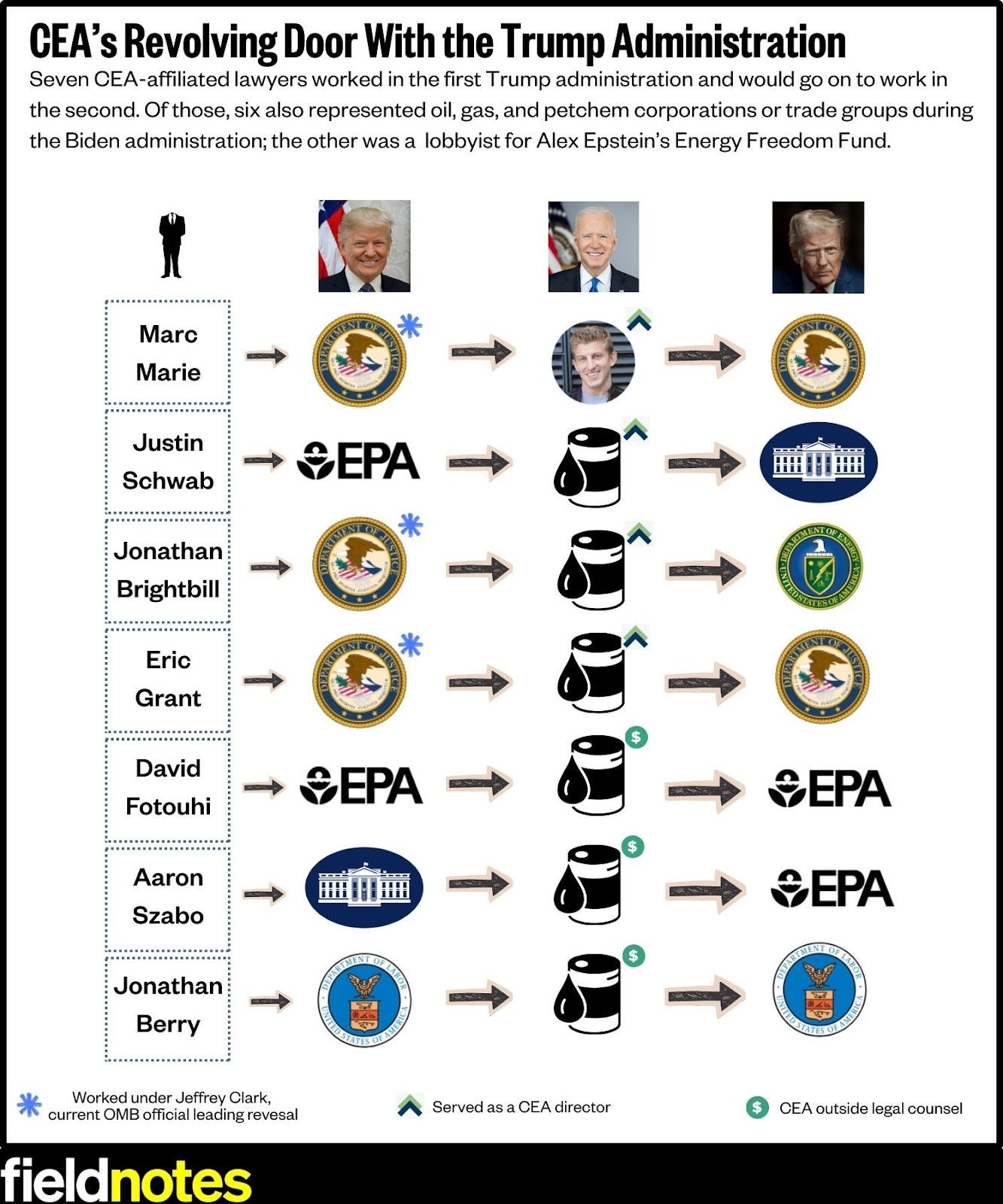
You can find our full investigation into CEA here and Politico’s story building off of it here ($). It completes something of a Fieldnotes investigative trilogy aimed at answering the question: Who, exactly, killed the endangerment finding?
Part I was last month’s New York Times story, based partly on confidential documents we obtained, that revealed how four MAGA activists dragged the endangerment repeal across the finish line, even after the oil & gas industry pumped the brakes. (Among them, not incidentally, was Jonathan Brightbill, one of CEA’s founding board members.)
Part II was Julia Kane’s and my collab with HEATED explaining why the American Petroleum Institute, which for years had led the charge to repeal the finding, took its foot off the metaphorical gas—specifically, out of a genuine fear that the end of endangerment will, somewhat counterintuitively, make it far more difficult for the oil & gas corporations API represents to continue to avoid paying for the climate damages they’ve wrought.
Part III was our CEA investigation, first reported on exclusively by Politico, which makes plain that regardless of who delivered the actual endangerment death blow, it almost certainly wouldn’t have happened without the legal infrastructure that the fossil fuel industry created and continues to fund today.
And while the MAGA culture warriors and the oil & gas companies weren’t marching in lockstep on this particular issue, there’s already evidence to suggest any daylight between them was short lived. Both are already coming together to try to shield corporations from the very climate lawsuits and state superfund laws that industry is so afraid of in a post-endangerment world.
Put another way, then, any dissonance between industry and the ideologues that emerged during the final push to kill endangerment doesn’t change how we got here; it simply points to where oil & gas companies and their far-right allies want to go next.
 | A guest post by
|